Missouri Vegetable Planting Dates: Regional Timing for Every Crop
A Missouri planting calendar is useful only when it matches your county and the crop you want to grow. A statewide date can be too early for one garden and unnecessarily late for another. This guide shows how to find the right regional dates, read them crop by crop, and turn them into a practical plan without treating any date as a guarantee.
Why Missouri planting dates vary by location
According to University of Missouri Extension, planting dates depend on where you live. That is the starting point for planning: the date that works for a gardener in one part of Missouri may not be the right date for a gardener elsewhere in the state.
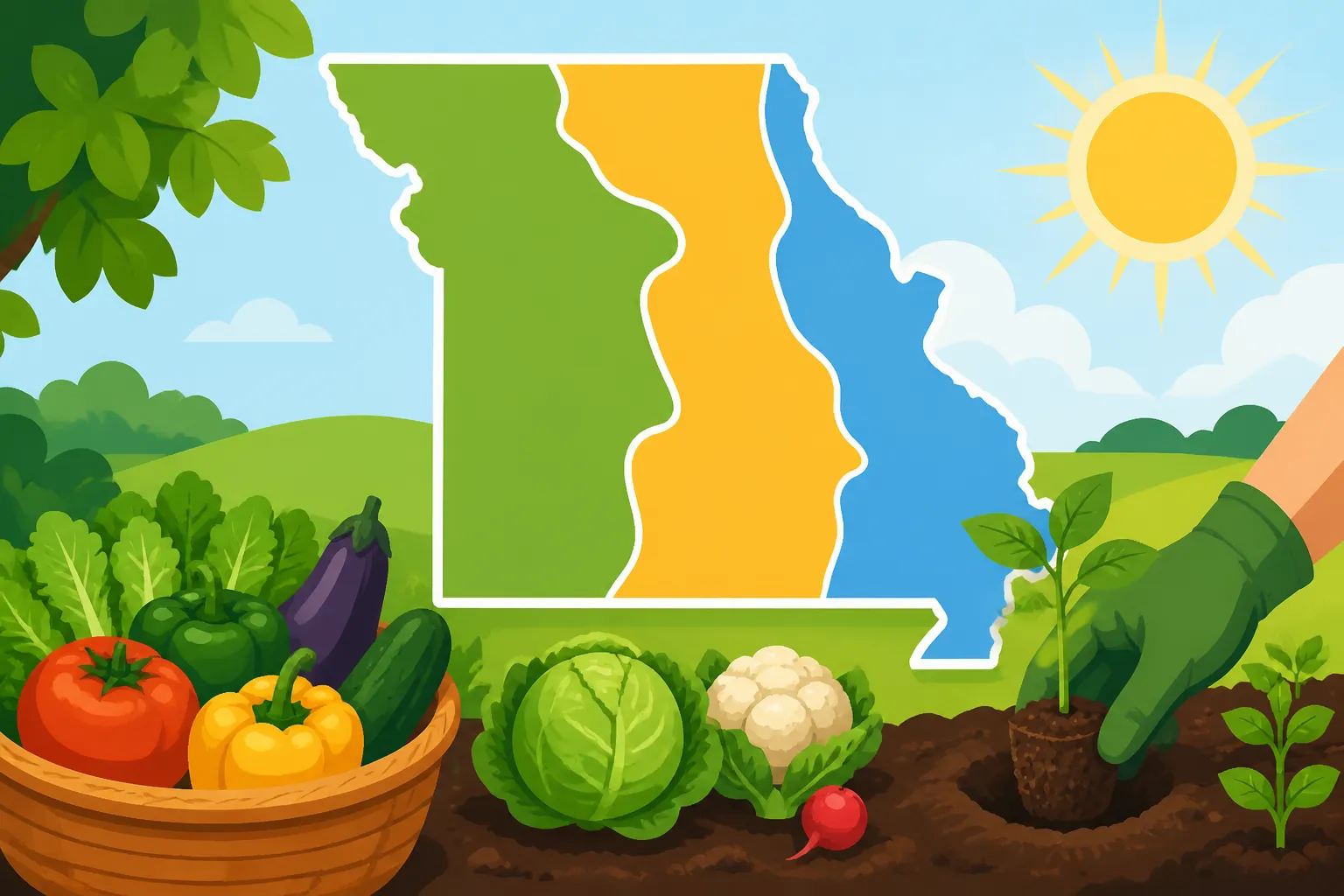
A regional calendar accounts for differences in local growing conditions that affect when sowing or transplanting is practical. The relevant region is not something to guess from a garden’s general reputation, a neighboring county’s advice, or a date remembered from a previous season. Begin with the county map provided with the planting information, then follow the dates assigned to your county’s region.
University of Missouri Extension recommends identifying your planting region using the county map; use the dates given for your region in Table 2. That instruction is more useful than trying to build a calendar from a statewide average. If a neighbor gardens in another region, their schedule can still offer ideas, but it should not replace the regional dates for your own county.
The planting table is a planning reference, not a promise that the soil and weather will cooperate on a particular day. A listed date helps you decide when to prepare, sow, or transplant. It does not mean every garden bed is ready then, nor that an unexpected cold spell, wet stretch, or unusually warm period cannot change what makes sense.
This distinction matters most when gardeners share schedules online or compare notes across Missouri. A date can be accurate for the person who posted it and still be a poor recommendation for a different county. It can also be a good starting point but not a final decision for a garden with unusually wet soil, a sheltered site, or a cooler low spot.
For background on how seasonal risk fits into the calendar, see Spring Planting in Missouri: Timing Around Late Frosts. For a broader look at how frost information and regional planning relate, Missouri Frost Dates and Hardiness: Master Planting Calendar can help clarify why a single date should not be treated as a guarantee.
Find your county’s region before choosing a date
The first job is locating your county on University of Missouri Extension’s county map. Once you know the planting region assigned to that county, use the corresponding dates in Table 2. Keep the map and table together while planning; looking at one without the other can lead to using dates for the wrong part of the state.
A practical check is to write the county and region at the top of your own calendar before entering any crop dates. That simple note helps prevent a common mix-up: copying advice from a source that names a nearby town or another region, then assuming it applies everywhere. If the source does not identify the relevant region, treat its date as general context rather than a substitute for the county-based table.
It is also worth keeping the official table accessible when you make later decisions. Garden plans change. A bed may be delayed by rain, a seed packet may be unavailable, or a gardener may decide to add another crop. Returning to the regional table makes it easier to check the new choice against the same planning basis rather than piecing together dates from unrelated advice.
When reading the map, do not infer a county’s region from its location on a casual sketch or from a border that looks close to a neighboring area. Use the map itself. If your county is near a regional boundary and the map is hard to interpret, consult University of Missouri Extension’s official materials or ask the Extension office for help identifying the correct region. Do not assume a county belongs to the region that seems most convenient.
Once you have the region, keep the date information attached to the crop name. A date copied into a notebook without its crop, action, or regional context can become misleading later. For example, a calendar entry should make clear whether it applies to sowing seed outdoors, starting seed indoors, or moving a transplant to the garden. Those are different tasks, and a date for one should not be silently used for another.
If you are also comparing a planting calendar with a hardiness-zone map, keep the purpose of each resource straight. Why Hardiness Zones Differ From Spring Planting Dates explains why a zone designation is not a replacement for a regional planting schedule. The county map and Table 2 are the tools to use for the regional vegetable dates described here.
Read the table one crop and one task at a time
A planting table is easiest to use when you read it as a set of crop-specific decisions rather than as a single “start planting” date. Find the crop you intend to grow, identify the action named in its row or column, and check that information against the region for your county. Do not transfer a date from a related crop unless the table explicitly supports doing so.
The distinction between sowing and transplanting is especially important. Some vegetables are commonly established by sowing seed directly where they will grow. Others may be started indoors and moved outside as transplants. A calendar entry for direct sowing does not automatically tell you when to start seed indoors, and an indoor-starting date does not automatically tell you when a transplant can go into the bed.
Use the table’s wording carefully. If it separates planting methods, preserve that distinction in your notes. If a crop has more than one recommended planting window, record each one as a separate opportunity instead of squeezing them into a single broad reminder. When the table gives a date for a particular method, follow that method’s entry rather than assuming the same timing applies to every way of growing the crop.
| What you are checking | What to record | Why it matters |
|---|---|---|
| Your county’s planting region | The region shown on the county map | It tells you which regional dates to use |
| The crop name | The name as it appears in the table | Similar crops can have different recommendations |
| The planting method | Direct sowing, indoor seed starting, or transplanting, when specified | Each method is a different task |
| The regional date | The date listed for your county’s region | It keeps the calendar tied to the correct location |
| Garden conditions | Whether the bed is workable and suitable for planting | A calendar date cannot make unsuitable soil ready |
| Any follow-up opportunity | A later planting window, if the table gives one | It can help organize continued sowing |
The table should also guide what you do when a crop is missing or the wording does not match your plan. Do not fill the gap by borrowing a date from a vegetable that looks similar. Check University of Missouri Extension’s current gardening information for that crop, or ask the Extension office for clarification. A recommendation for one crop may not transfer to another just because they belong in the same broad group in a home garden.
Likewise, do not assume a date means “plant under any conditions.” If the bed is waterlogged, crusted, or otherwise difficult to work, planting on the listed date may cause more trouble than waiting for a suitable opportunity. The calendar tells you when to consider a task; the condition of the garden tells you whether the task is practical that day.
For help distinguishing indoor seed starting from outdoor planting, see When to Start Seeds Indoors and Transplant Outdoors in Missouri. If your question is specifically about warm-season crops and spring soil conditions, When Warm-Season Crops Can Safely Go Into Spring Garden Soil offers a related planning perspective.
Turn regional dates into a working garden calendar
A useful calendar connects each crop’s regional date with the work that must happen before and after it. Start with the crop list you actually intend to grow. Then copy the relevant entry from Table 2 for your county’s region, preserving the crop name and planting method. This gives you a reliable framework without crowding your notes with dates for vegetables you do not plan to plant.
Next, make the calendar practical. Add reminders for tasks that support planting, such as checking seed packets, preparing a bed, arranging transplants, and confirming that the garden is ready. Keep these reminders separate from the official regional date. That way, a reminder to prepare does not get mistaken for a recommendation to put seed or a transplant in the ground.
It helps to organize entries by what you need to do rather than by a vague season label. A note such as “check regional table for this crop’s outdoor sowing window” is more useful than a general reminder to “plant vegetables.” If you start seedlings indoors, give that task its own entry. If you plan to buy transplants, note when you intend to find them and when the regional table says to consider planting them outdoors.
A practical sequence for each crop is:
- Confirm that the crop appears in the planting information, and check whether the table distinguishes planting methods.
- Match the crop to the dates for your county’s region.
- Put the regional date into your plan with the crop and method clearly identified.
- Prepare the bed and gather supplies before the planting opportunity arrives.
- Recheck the weather and soil conditions as the planned task approaches.
- Adjust the day of the work if conditions make planting impractical, while retaining the regional date as your reference point.
This approach reduces last-minute decisions. It also makes it easier to see which jobs compete for your time. If several crops have planting opportunities close together, you can prepare beds and supplies in advance rather than trying to do everything at once. You can also decide whether to scale back a plan that is larger than the time or space you have available.
For indoor-started vegetables, keep the indoor and outdoor stages connected but separate. Your indoor sowing reminder should be based on guidance for starting seeds, while the outdoor move should be checked against the appropriate regional planting information and current conditions. Do not calculate one date from the other unless the relevant recommendation gives a method for doing so. How to Calculate Indoor Sowing Dates Before Moving Crops Outside is useful when you are planning that sequence.
For gardeners who want both spring and fall crops, think of the calendar as a sequence of opportunities rather than one annual planting day. Plan the spring crops from their regional entries, then use the applicable fall guidance for crops intended for a later harvest. A spring date should not be reused as a fall recommendation. Planning Sowing Dates for Both Spring and Fall Vegetable Harvests can help with the larger seasonal plan, while Planning a Missouri Home Orchard for Summer and Fall Fruit is a separate topic for fruit rather than vegetables.
Plan by crop group without substituting one crop’s dates for another
Grouping crops can make a garden plan easier to manage, but groups are for organizing work, not for inventing shared planting dates. Use the official entry for each crop. The overview below helps you think through the kinds of decisions involved while leaving the actual regional date to Table 2.
| Planning group | Useful question to ask | Calendar detail to keep distinct |
|---|---|---|
| Crops sown directly outdoors | Does the table give an outdoor sowing entry for this crop? | Direct sowing is not the same as indoor seed starting |
| Crops commonly moved as transplants | Is the listed date for planting a transplant outdoors? | A transplant date does not automatically set the seed-starting date |
| Crops with more than one planting opportunity | Does the table show separate windows or entries? | Record each opportunity rather than combining them |
| Crops not clearly listed | Is there specific guidance for the crop elsewhere? | Do not borrow another crop’s date |
| Crops planned for a later-season harvest | Is there a separate fall recommendation? | Do not use a spring entry as a fall date |
For direct-sown crops, the question is whether the regional table provides an entry for sowing outdoors. If it does, use that crop’s entry for your region. If the crop is not included or you cannot tell whether the recommendation is for direct sowing, look for crop-specific guidance instead of using a date assigned to another vegetable.
For transplant crops, distinguish the work of growing or buying a young plant from the work of putting it in the garden. The transplant can be ready before the bed or outdoor conditions are suitable. Conversely, a regional outdoor planting date does not tell you how long to grow a seedling indoors. Keep the two decisions linked in your notes but grounded in the guidance intended for each one.
For crops that may be planted more than once, treat each window as its own planning event. A later sowing can have a different purpose from an earlier one, and it may face different conditions as the season progresses. If the table provides separate opportunities, copy them separately. If it does not, avoid assuming a repeat interval or creating a new date on your own. Missouri Succession Sowing for April-to-October Vegetable Beds discusses succession planning, but the dates for your county and crop still need to come from the relevant regional information.
For fall planting, start with guidance that is explicitly intended for a fall crop. The conditions and goals are not identical to spring planting, so using the spring entry as a shortcut can put a crop in at the wrong stage of the season. When the official source lists a fall planting period, record that independently and plan backward from it only where the source provides a suitable method. Will Late-Planted Fall Vegetables Beat the First Autumn Frost? is relevant when weighing a late-season plan.
This crop-by-crop discipline may feel slower than using a generic chart, but it prevents errors that are hard to spot later. A calendar with a precise regional date for the wrong task is not more useful than a general reminder. Keeping crop, method, region, and date together makes the recommendation understandable when you return to it.
Adjust the plan to the garden without losing the regional reference
The regional planting date is a guide, not a command to work in unsuitable conditions. Before sowing or transplanting, look at the actual bed. Is the soil workable? Can you prepare it without smearing or compacting it? Is the site likely to stay wet? Are the plants protected or exposed? These observations help you decide whether to act on the planned day or wait for a more suitable opportunity.
Soil condition matters because a date on a calendar cannot improve a bed that is too wet to prepare. If digging or cultivating leaves the soil sticky and clumped, consider postponing bed work rather than forcing it. If the surface dries quickly while deeper soil remains damp, do not rely only on what you see at the top. Why Dry Surface Soil Can Deceive Missouri Gardeners and Improving Drainage in Wet Missouri Spring Vegetable Beds offer more detail on those kinds of garden conditions.
Weather is another reason to keep the date flexible. A short warm spell can make planting feel urgent, but it does not guarantee that conditions will stay favorable. A return to chilly weather can affect tender crops differently from crops that tolerate cool conditions. The regional table remains your baseline; current weather helps you decide whether a particular day is a sensible time to do the planned job.
Use a forecast as a prompt to review your plan, not as proof that a crop is safe to plant. If the forecast suggests a cold period, consider whether the crop is a tender transplant, whether the bed is exposed, and whether you have a suitable way to protect it. If protection is not practical, waiting may be the simpler choice. For specific strategies, see Protecting Early Transplants When Chilly Spring Nights Return and Emergency Frost Protection Covers for Tender Missouri Seedlings.
A garden’s small-scale conditions can also differ within the same property. A low area may hold water or feel colder than a raised, sheltered bed. A sunny wall or wind-exposed edge can change how a site behaves. Those differences do not change the county region on the official map, but they can affect whether your particular bed is ready for a planned task. Record these observations over time so that future decisions reflect your site as well as the regional table.
If you have to postpone planting, do not assume that the entire season is lost. Check whether the crop has another recommended opportunity, whether a different crop better fits the remaining plan, or whether the planting can be reduced to a smaller area. Avoid inventing a late date by moving the spring recommendation on the calendar. For a delayed plan, Late Planting Options in Missouri for Summer and Fall Harvests can help you consider alternatives, while the crop-specific regional information remains the source for any dates.
Finally, review your calendar after the season. Note what was planted, what conditions caused a delay, and which beds stayed wet or warmed slowly. These observations do not replace official recommendations, but they can make your next season’s preparation more realistic. Keep the notes clearly marked as observations from your garden, not as statewide planting rules.
Frequently Asked Questions
Where should I find the planting dates for my county?
Use the University of Missouri Extension county map to identify your planting region, then consult Table 2 for that region. Keep the crop and planting method matched to the entry.
Can I use a planting date from another Missouri county?
Treat it as background, not as a substitute for your own county’s regional dates. The right reference is the region shown for your county on the map.
Does the date mean I should plant regardless of the weather?
No. Use the regional date as a planning reference, then consider whether the soil and weather make planting practical. A scheduled date cannot guarantee suitable conditions.
What if the crop or planting method is not clear in the table?
Look for crop-specific guidance from University of Missouri Extension or ask the Extension office for clarification. Avoid borrowing a date from a similar-looking crop or assuming a sowing date applies to transplanting.
Sources
- University of Missouri Extension — Vegetable Planting Calendar | MU Extension (checked November 15, 2026)
Disclaimer
This article is for general informational purposes only and does not constitute professional advice. Laws, prices and regulations vary by location and change over time. Consult a qualified professional for guidance on your specific situation. Missouri Gardening Guide is not a government agency and is not affiliated with any university extension, state department of agriculture or other government agency.