Hardiness Zones of Central Missouri and Statewide Areas
Choosing a tree, shrub, perennial, or fruit crop for a Missouri yard often starts with a hardiness zone. The challenge is that zone labels are easy to mistake for a guarantee of winter survival—or for a planting calendar. Here’s how to read the statewide pattern, understand what the map can tell you about central Missouri, and use it alongside local growing conditions.
What a hardiness zone tells you
A plant hardiness zone is a tool for comparing the winter cold a plant is expected to tolerate with the winter conditions in a location. It helps narrow a plant list, especially when deciding whether a perennial or woody plant is likely to survive winter outdoors. It does not promise that a plant will thrive, nor does it describe every condition that affects the yard.
According to the University of Missouri Integrated Pest Management Program, most of Missouri is in USDA 2023 zone 6, with an average winter low temperature from 0 to -10 degrees F.
That statewide summary is a useful starting point, not a description of every property. A state map is divided into areas with different zone labels, and a location close to a boundary may be represented differently from a nearby spot. A map also cannot capture every sheltered corner, exposed slope, or low area in a garden.
On the USDA 2023 map, zone 6 is divided into half-zones 6a and 6b, according to the University of Missouri Integrated Pest Management Program. These subdivisions provide more detail within the broader zone. They are useful when a plant listing gives a narrower hardiness range, but they still represent a regional estimate rather than a precise measurement from a particular yard.
A zone label is best treated as one piece of a plant’s suitability check:
- Winter tolerance: Is the plant considered hardy for the zone shown for the location?
- Growing conditions: Does it suit the site’s sunlight, drainage, soil, and exposure?
- Seasonal timing: Does it have enough time to grow, flower, or produce fruit under local conditions?
- Establishment: Can a new planting get rooted and settled before stressful weather arrives?
- Ongoing care: Will the plant need protection or maintenance that the gardener can provide?
That distinction matters for both new and experienced gardeners. A plant may be rated hardy for a zone yet struggle in a wet, compacted bed or in a spot with strong winter exposure. Conversely, a sheltered location may reduce stress for some plants without changing the zone assigned to the surrounding area. Use What Hardiness Zones Actually Tell Missouri Gardeners for more on what a zone rating can and cannot predict.
The statewide pattern and central Missouri
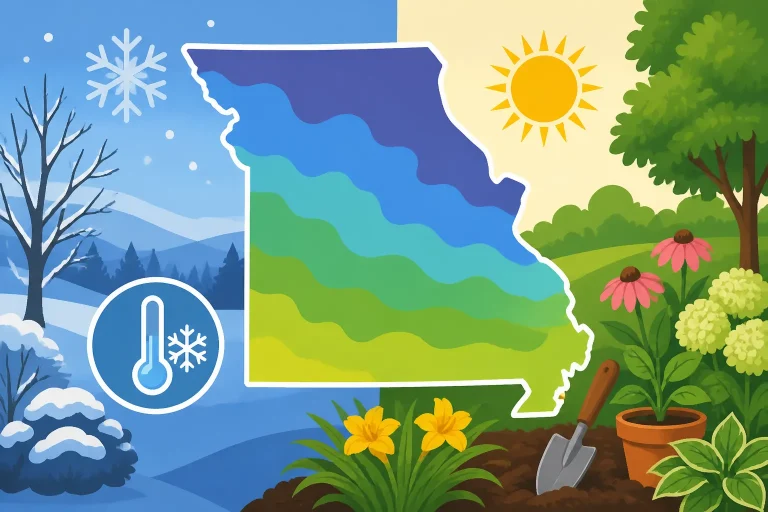
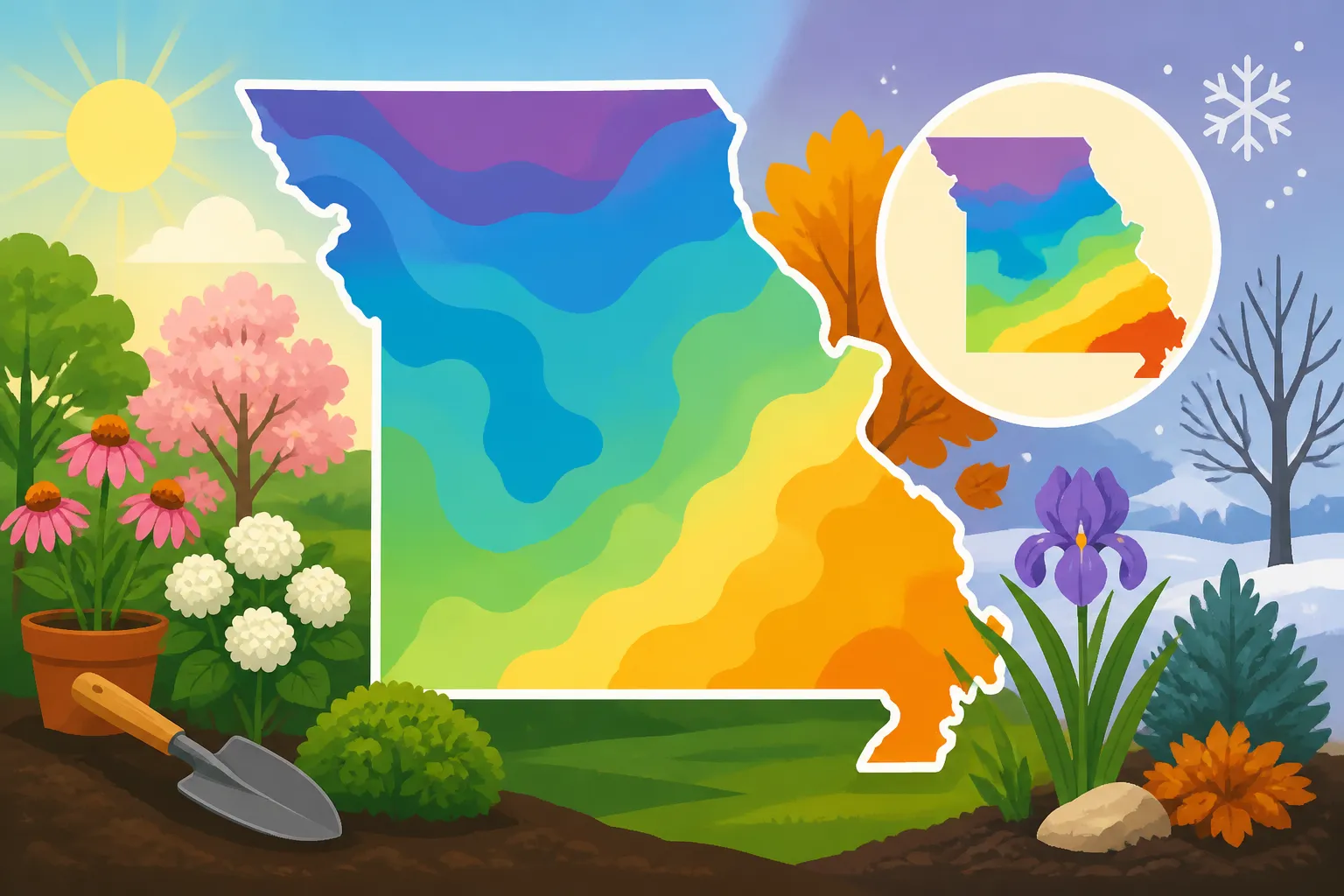
According to University of Missouri Extension, the 2023 USDA map divides Missouri into five zones: 5b, 6a, 6b, 7a and 7b.
That range shows why it is risky to apply a single statewide label to every Missouri yard. The general statement that most of the state falls in zone 6 does not mean every part of Missouri—or every neighborhood in central Missouri—has the same map designation. A gardener needs to identify the area shown on the current map for the location, then use that as a starting point for selecting plants.
Central Missouri gardeners should resist relying on a broad regional description alone. The phrase “central Missouri” covers more than one possible map location. A town name, a regional label, or a neighbor’s zone may not settle which map area best represents a particular property. Use a current map or ZIP-code lookup to locate the area, then consider whether the garden itself has conditions that differ from the broader surroundings. Find Your Missouri Hardiness Zone by ZIP Code explains how to start that lookup.
The map is useful for comparing places, but its boundaries are not property lines. A line on a map does not mean that every garden on one side has identical winter conditions, or that plants on the other side face a completely different climate. It divides a broad landscape into categories that help organize plant hardiness information. Near a boundary, it is sensible to be conservative when choosing a plant whose survival depends on a narrow hardiness margin.
| What you are checking | What the zone map can help with | What to check separately |
|---|---|---|
| Winter survival | Whether a plant’s hardiness listing appears compatible with the mapped area | Whether the plant is exposed, newly planted, or in a cold pocket |
| Central Missouri location | Which zone area the location falls in on the map | Whether a broad regional description is too general for the property |
| Plant selection | Which candidates deserve closer consideration | Sun, soil, drainage, moisture, and maintenance needs |
| Spring planting | The broad winter-hardiness context | Frost risk, soil conditions, and the crop’s temperature needs |
| Long-term planning | Comparing plant listings across a yard or region | Whether a plant will receive suitable care and growing conditions |
When reading a statewide map, avoid drawing conclusions from color alone. Find the legend, check the zone labels, and confirm that the map is the USDA Plant Hardiness Zone Map edition being discussed. If a plant tag or catalog uses a zone rating, compare it with the map’s actual label rather than assuming a neighboring place has the same rating.
For central Missouri, the practical takeaway is not to memorize a single regional zone. Locate the property on the map, then treat the result as a useful screening tool. If the location is near a zone boundary or the plant is a borderline choice, look for more than one source of guidance, including plant-specific recommendations and the experience of local gardeners.
How to use a map for a specific property
A map gives a regional answer. Gardeners need to turn that answer into a decision about a particular bed, border, orchard, or container. That takes a little more care than reading a label, but it can prevent avoidable losses.
Start with the location rather than the plant. Use the map or a ZIP-code lookup to see which zone area the location falls in. ZIP codes are a convenient way to begin, not a promise that every address within one ZIP code has identical conditions. If the property is close to a mapped boundary, check the map itself rather than relying on a broad summary.
Next, compare the plant’s hardiness information with the map result. Plant tags, nursery descriptions, and reference materials may give a range or a lowest zone. Check whether the plant is suitable for the mapped area, and read the wording carefully: a plant rated for colder conditions may be a different decision from one that is only described as suitable in warmer areas. If the listing is unclear, seek a reliable plant-specific recommendation instead of guessing from the plant’s name or appearance.
Then inspect the planting site. The map cannot show whether a bed is wind-exposed, shaded, waterlogged, or sheltered by a building. Those details affect plant health and can make the same species perform differently in different parts of a yard. A sheltered position may ease exposure, while poor drainage or persistent moisture can create problems unrelated to hardiness.
A practical order of checks is:
- Confirm the map area. Locate the property on the USDA Plant Hardiness Zone Map and note the mapped zone.
- Read the plant listing closely. Look for the hardiness range and any qualifications about exposure, soil, or moisture.
- Assess the planting spot. Notice sunlight, wind, slope, drainage, and nearby structures or vegetation.
- Consider establishment. A newly planted specimen may need extra attention while its roots become established.
- Plan for uncertainty. If the plant is a marginal choice, decide whether the risk of winter loss is acceptable or whether a more reliably hardy option makes more sense.
This process is particularly useful for trees, shrubs, vines, and perennial flowers that remain outdoors through winter. Replacing a failed plant can take time and money, and woody plants may take years to reach the size or form intended for a landscape. For a plant that is central to the design, favor a selection with a comfortable hardiness margin rather than choosing one whose suitability is uncertain.
Hardiness labels should also be read in context. A nursery’s rating may be a general description, while a plant-specific source may explain how performance depends on drainage, winter protection, or exposure. Look for agreement across credible recommendations. If information conflicts, choose the more cautious option or ask a knowledgeable local source before committing to a large planting.
For help narrowing down broader landscape choices, Choosing the Right Tree for Your Missouri Yard and Soil and Matching Missouri Perennials to Garden Sun, Soil, and Season can help connect plant selection with site conditions.
Hardiness zones are not a planting calendar
A common mistake is to treat a hardiness zone as a schedule for sowing or transplanting. The zone map is about winter cold tolerance; it does not tell you when soil is ready, whether spring frost risk has passed, or whether a particular crop can handle chilly nights.
That difference matters in Missouri, where gardeners make separate decisions about long-term plant survival and short-term seasonal timing. A tomato may be able to grow well through the warm part of the season but still be damaged by cold weather after it is planted out too early. A perennial may be hardy enough to survive winter but still need a suitable planting window and good establishment conditions.
For vegetables, use a crop-specific schedule and local frost information rather than using the hardiness zone as a planting date. The zone does not provide a forecast for the coming season or tell you whether a cold night is imminent. It also does not tell you whether a garden bed has warmed enough for a particular seed or transplant.
The distinction can be summarized this way:
- Hardiness zone: Helps assess whether a plant is suited to the area’s typical winter cold.
- Frost information: Helps assess the likelihood and timing of frost or freezing conditions.
- Crop calendar: Helps plan sowing and transplanting by crop and region.
- Current weather: Helps decide whether conditions are suitable for an immediate task.
- Garden site: Helps determine whether the conditions at the bed match the crop’s needs.
For seasonal vegetable planning, Missouri Vegetable Planting Dates: Regional Timing for Every Crop is a better starting point than the hardiness map alone. For spring timing, Spring Planting in Missouri: Timing Around Late Frosts and Why Hardiness Zones Differ From Spring Planting Dates address the difference between winter tolerance and spring planting windows.
A calendar is still a guide, not a guarantee. Weather can vary, and a planting date that works in one location may not suit a different part of the state or a site with unusual conditions. Before planting tender crops, check local weather and the crop’s needs. For guidance on deciding whether it is time to move a tender plant outside, see When Is the Safe Window to Move Tender Transplants Outdoors?.
The reverse is true as well: a favorable planting window does not make an unsuitable plant winter-hardy. A garden can have a good season for establishment and still face winter conditions that exceed a plant’s tolerance. Keep the two questions separate: “Can this plant survive here over winter?” and “Is this a good time to plant it?” Answering both leads to a more reliable plan.
Site conditions that a zone label cannot show
A hardiness zone is a broad tool, so it cannot describe every condition that affects a planting. Even within one yard, the exposure and moisture of one bed can differ from another. Those differences do not change the zone shown on the map, but they can influence how well a plant grows and how vulnerable it is to stress.
Exposure and shelter
Open areas can expose plants to wind and winter weather, while locations near a building, fence, or dense planting may be more sheltered. Shelter can affect the conditions a plant experiences, but it is not a substitute for checking the plant’s hardiness. Structures can also create shade or alter airflow, so a sheltered site is not automatically the best site.
Observe the planting area during different weather and seasons. Consider whether it receives direct sun, whether strong winds hit it, and whether the chosen plant can tolerate those conditions. A plant placed against a warm wall may have a different pattern of exposure from one in an open bed, but the map designation for the broader location remains the starting point.
Drainage and soil
Wet soil can stress roots and create a poor planting environment, even for a plant whose hardiness rating appears suitable. Heavy or compacted ground may drain slowly, while a raised or sloped site may shed water more readily. Check how water behaves after rain and whether the bed stays saturated or dries rapidly.
Soil texture and fertility also matter. A zone map does not provide a soil test or tell you whether the soil is appropriate for a particular plant. Before making major amendments, understand the actual soil conditions and follow recommendations tailored to the planting. Soil Prep and Fertility Basics for Missouri Vegetable Beds covers the fundamentals for vegetable beds, while Testing Garden Bed Soil Drainage Before Planting Missouri Flowers focuses on assessing a flower-bed site.
Low spots and local cold pockets
A garden’s position in the landscape can matter. Low spots may hold cold air or moisture differently from higher ground, and nearby barriers can influence airflow. These effects are local; they are not a reason to assign a different hardiness zone to an individual address. Instead, use them to interpret why one planting site may be more challenging than another.
If a plant has failed in one location, consider the full set of conditions before blaming the zone. Ask whether the planting spot was unusually wet, exposed, shaded, or slow to drain. A different location in the yard might suit the same plant better, or the plant may simply be a poor match for the property’s conditions.
Containers and raised beds
Plants in containers experience different conditions from plants rooted in the ground. A container has limited soil volume and may be more exposed to changing temperatures and moisture. A raised bed may also warm or dry differently from surrounding ground. Neither type of planting automatically changes the map zone, but both can call for extra attention to watering, insulation, and plant selection.
For container gardeners, the practical lesson is to avoid assuming that a plant suitable for an in-ground bed will perform identically in a pot. Match the plant to the container’s size, drainage, and exposure, and consider whether the container can be moved or protected during stressful weather. For more on garden layouts, see Raised Beds, Containers, or In-Ground: Missouri Garden Layouts.
Choosing plants and planning for survival
Once the map location is clear, use hardiness as a filter rather than as the whole selection process. Start by listing the plants you want, then compare their winter tolerance with the mapped area. After that, check whether each candidate suits the actual site and the kind of care you can provide.
For landscape plants, this helps avoid a common mismatch: selecting a plant because it looks attractive or is described as suitable for the broad region, without checking its needs. A tree that can tolerate local winters may still be a poor choice for a narrow planting strip or wet ground. A perennial that is hardy may not flower well in deep shade. A shrub may survive but require more pruning or water than the gardener wants to manage.
For edible perennial plants, the decision can affect the harvest as well as survival. Fruit trees, berries, and grapevines have site and care requirements beyond cold tolerance. Consider the location’s sun, drainage, space, and maintenance demands along with the hardiness information. Planning a Missouri Home Orchard for Summer and Fall Fruit and Growing Cane Berries and Brambles Across Missouri Yards offer more specific planning considerations.
When several plants would suit the design, give preference to one with clear, credible hardiness information and a good match to the site. If a desired plant is at the edge of its stated range, weigh the consequences of failure. It may still be a reasonable experiment in a protected location, but a less marginal choice is usually better for a permanent or costly planting.
Planting technique also influences establishment. Prepare a site that drains appropriately, avoid placing plants where their mature size will be cramped, and provide the care needed for roots to establish. Good planting and maintenance cannot make every plant survive every winter, but they reduce avoidable stress and make the plant’s real hardiness a more meaningful part of the decision.
A simple plant-selection worksheet can help:
| Question | Useful decision |
|---|---|
| What zone area does the map show for the location? | Use the mapped result as the winter-hardiness screening point |
| What hardiness range does the plant listing give? | Compare the range with the map and note any uncertainty |
| Does the site suit the plant? | Check light, drainage, soil, moisture, and exposure |
| Is the plant a long-term investment? | Be more cautious if replacement would be difficult or costly |
| Is the plant a borderline choice? | Seek plant-specific guidance or select a more reliable alternative |
Do not use a single successful planting nearby as proof that every plant of the same type will succeed everywhere in central Missouri. Nearby gardens can differ in exposure, soil, water, and care. Local experience is valuable, especially when it includes the site conditions and the plant’s history, but it works best alongside a map and reliable plant information.
A practical routine for using Missouri zone information
The most useful approach is to check the map when making plant choices, then revisit the other conditions that shape the decision. This makes the zone a practical tool rather than a label to memorize.
- Look up the location. Use the USDA Plant Hardiness Zone Map or a ZIP-code lookup to identify the mapped area for the property.
- Check the plant’s hardiness listing. Compare the plant’s stated range with the mapped result. If the listing is vague, look for a more specific recommendation.
- Inspect the planting location. Assess sun, wind, drainage, soil, slope, and shelter rather than assuming the whole yard is uniform.
- Separate winter survival from planting timing. Use local frost guidance and crop-specific schedules for sowing or transplanting.
- Choose the level of risk. For a permanent feature or valuable plant, favor a reliable match. Treat a borderline choice as an experiment, not a sure thing.
- Keep notes. Record what was planted, where it was planted, and how it performed. Over time, these observations help identify which parts of the yard are exposed, wet, shaded, or otherwise challenging.
This routine is useful when buying plants, planning a new bed, replacing a plant that failed, or deciding whether to keep a marginal specimen. It can also help when comparing advice from labels, catalogs, and neighbors. If information conflicts, verify the map location and look for a reliable plant-specific recommendation before making a high-stakes choice.
The central point is simple: a hardiness zone is a regional winter-cold guide, not a verdict on a whole property and not a complete planting calendar. For central Missouri and elsewhere in the state, use the mapped area to narrow plant choices, then consider the garden’s own conditions and the plant’s needs. That combination is more useful than relying on a zone label alone.
Frequently Asked Questions
Does a ZIP code identify the exact hardiness zone for every yard?
A ZIP-code lookup is a useful starting point, but it does not describe every property’s microclimate. Check the map itself, especially if the location is near a boundary, and consider the site’s exposure and drainage.
Does a suitable zone mean a plant will thrive?
No. A compatible hardiness rating addresses winter cold tolerance, not every factor that affects growth. Sunlight, soil, drainage, moisture, pests, and care still matter.
Should I use a hardiness zone to decide when to plant vegetables?
No. Use crop-specific timing and local frost information for sowing and transplanting. A hardiness zone helps assess winter survival, not the weather conditions for a particular planting day.
What should I do if a plant is a borderline choice?
Check for dependable plant-specific guidance and consider whether the planting site is exposed or sheltered. If losing the plant would be costly or difficult to replace, choose a less marginal option.
Disclaimer
This article is for general informational purposes only and does not constitute professional advice. Laws, prices and regulations vary by location and change over time. Consult a qualified professional for guidance on your specific situation. Missouri Gardening Guide is not a government agency and is not affiliated with any university extension, state department of agriculture or other government agency.